2025 International Medical Artificial Intelligence Conference and Artificial Intelligence Summer School were successfully held: jointly drawing a new blueprint for smart medical care
- IMIC Lab
- News , Comprehensive news
- September 6, 2025
From July 27 to 30, 2025, the “2025 International Medical Artificial Intelligence Conference and Artificial Intelligence Summer School” was successfully held in the lecture hall of Area D, Linjiang Building, Nanjing University of Information Science & Technology.
With the theme of “Smart Health: Medical Technology Innovation Driven by Artificial Intelligence”, this conference brought together senior professors and experts from many internationally renowned universities such as the Universidad Nova de Lisbon in Portugal, the University of Leicester in the United Kingdom, the Sapienza University of Rome in Italy, the University of Nottingham in Malaysia, Osaka University in Japan, and Kyungpook National University in South Korea. Focusing on the two dimensions of core technology and innovative applications of medical artificial intelligence, the guests conducted in-depth discussions on cutting-edge topics such as computer vision, pattern recognition, large language models, big data analysis, wearable devices, multi-modal physiological signal processing, medical digital twins, artificial intelligence optimization of clinical pathways, and computational pathology.
The conference not only focused on the academic frontier and industrial transformation of medical artificial intelligence, and promoted the in-depth integration of industry, academia and research, but also specially set up an artificial intelligence summer school to provide an international learning platform covering basic theories and innovative applications for undergraduates, graduate students and personnel in related fields both inside and outside the school, and to help cultivate the next generation of innovative medical AI talents with interdisciplinary capabilities. It will contribute to deepening cooperation and personnel exchanges between Chinese and foreign universities in the field of artificial intelligence, implementing the “Healthy China” strategy, accelerating the training of artificial intelligence talents, and assisting the integrated and high-quality development of education, science and technology talents.
During the meeting, João Sàágua, President of the New University of Lisbon in Portugal, and his delegation visited our school to further promote the strategic cooperation between the two universities and the joint establishment of the China-Europe Medical Artificial Intelligence Institute. The delegation visited the China-Europe Institute of Medical Artificial Intelligence in Linjiang Building and observed a demonstration project based on multi-modal physiological signal technology to restore the hand movements of an artist playing the small sanxian in “The Romance of the West Chamber”. This research project was co-initiated with Professor Tan Xin, Director of the Music Education Department of the School of Music of Nanjing Normal University. By collecting electromyographic signals and motion acceleration data, the system accurately analyzed the performance movements and states, reflecting the innovative application of artificial intelligence in the intersection of cultural heritage and medical health. Next, Xu Jun introduced to President João Sàágua the work of the Jiangsu University Key Laboratory of Intelligent Medical Image Computing in computational pathology and image analysis, and the plan of the laboratory and the China-Europe Medical Artificial Intelligence Institute to integrate two-dimensional image data with one-dimensional physiological signals for disease analysis and early prevention and early warning.
Video 1: João Sàágua, President of the New University of Lisbon in Portugal, and his delegation visited the China-Europe Institute of Medical Artificial Intelligence
Video 2: The artist plays the “Yingying Tingqin” in Xiao Sanxian’s “The Romance of the West Chamber”. By using the wearable sensor developed by SEAM, the electromyographic signal and motion acceleration data are collected in real time, and the system accurately analyzes the movements and status of the Xiao Sanxian’s “The Romance of the West Chamber”.
Video 3: Demonstrates the use of a lightweight and convenient wearable sensor developed by SEAM attached to the artist’s wrist to collect myoelectric signals and motion acceleration data in real time, and the system accurately analyzes performance movements and status.
Opening Ceremony: Discussing cooperation and looking forward to the new future of medical artificial intelligence
On the morning of July 28, the meeting officially opened in a warm atmosphere. Xu Jun, deputy dean of the School of Artificial Intelligence (College of Future Technology), presided over the opening ceremony. Ma Yan, member of the Standing Committee of the University Party Committee and Vice President, Academician Qin Ling of the Chinese University of Hong Kong, Professor Hugo Gamboa of the New University of Lisbon in Portugal, Professor Giovanni Saggio of the Sapienza University of Rome, Italy, Jiang Feng, Dean of the School of Artificial Intelligence (School of Future Technology), as well as specially invited experts from many countries and relevant leaders of the International Cooperation Office attended the ceremony.
Vice President Ma Yan said in her welcome speech that in recent years, Nanjing University of Science and Technology has closely focused on national strategies and industry needs to build two major scientific brands: “Meteorology +” and “+ Information”, and has achieved a series of breakthroughs in fields such as artificial intelligence and integrated circuits. She emphasized that medical artificial intelligence is the high ground of global technological competition and is profoundly reshaping the medical ecosystem. This conference is an important measure for the school to implement the “Healthy China” strategy and promote the integrated development of education, science and technology, and talents. Nanjing University is committed to working with global experts to promote the in-depth integration of intelligent medical research and development with industry, academia, research and application.
In his speech, President João Sáágua reviewed the long-standing cultural exchanges and knowledge cooperation between China and Portugal, affirmed the strategic partnership established between the two universities and the construction progress of the China-EU Institute of Medical Artificial Intelligence, and expressed his expectations for jointly promoting the innovative development of medical artificial intelligence in the future.
Academician Qin Ling pointed out that artificial intelligence has become a national strategy and has shown great potential in the medical field, such as improving diagnostic accuracy and realizing personalized treatment. At the same time, it also faces challenges such as ethics, data privacy, and integration with the traditional medical system. He emphasized that international cooperation and open dialogue should be strengthened to jointly respond to global medical issues.
Conference special reports and roundtable forum: Collision of frontiers, wisdom for the future
After the opening ceremony, the conference entered the special report session. Professor Hugo Gamboa from the New University of Lisboa in Portugal gave a systematic introduction to the technical path and application prospects of building a personal health quantification system through multi-dimensional data (such as web browsing records, mobile phone sensors, smart wearable devices, etc.) with the topic of “Quantified Self”.
Professor Giovanni Saggio from the Sapienza University of Rome, Italy, demonstrated the “sensing glove” developed by his team. This device can accurately capture hand movement data and has wide application value in fields such as virtual reality, robot control, and medical rehabilitation.
The subsequent roundtable forum, with the theme of “Opportunities and Challenges in Medical Artificial Intelligence Cooperation”, was chaired by Professor Hugo Gamboa. Academician Qin Ling, Professor Ana Londral, Professor Zhou Huiyu, and Professor Giovanni Saggio conducted in-depth discussions on the advantages, difficulties and prospects of China-EU cooperation. Experts agree that China and the EU have complementary advantages and can promote the development of medical AI through resource sharing and technology collaboration, but they also need to jointly address challenges such as data compliance and regulatory differences.
In the afternoon’s special lecture, Professor Ana Londral gave a speech entitled “From Research to Practice: The Key Role of Mission-Oriented Collaborative Teams in Medical Innovation”, emphasizing the importance of interdisciplinary teams to achieve technological transformation through in-depth user participation and real-life problem orientation.
Professor Zhou Huiyu of the University of Leicester, UK, in the report “When Histopathology Meets Artificial Intelligence”, systematically introduced the latest progress in quantitative analysis of pathological images and the application potential of machine learning in this field. At the conference, he demonstrated an efficient multi-scale segmentation method for colorectal tumors, achieving accurate region of interest extraction through RGB color model and histogram distance optimization, and using L2 norm sparse representation based on random projection to obtain ideal classification results; secondly, in view of the color normalization problems caused by staining and scanning of pathological images, innovative An unsupervised dual-channel representation learning model is proposed; finally, an unsupervised deep learning method inspired by nonnegative matrix factorization (NMF) is reported, which can deconstruct the input image into a stain matrix matrix and a stain concentration matrix, achieving breakthrough stain separation effects. In particular, the automated analysis of pathological images continues to attract widespread attention in the field of machine learning.
Professor Hamada Rizk from Osaka University, Japan, brought a topic titled “Smart Care in Intelligent Space: Privacy-Preserving Artificial Intelligence across Environmental Location-Behavior-Mobility”. He brought wonderful sharing to everyone with his profound knowledge accumulation in body-area sensors and ubiquitous mobile computing. Professor Hamada elaborated on how the integration of artificial intelligence and sensing technology is reshaping the human-computer environment interaction paradigm. He focused on the breakthrough applications of intelligent sensing and privacy-preserving AI in indoor positioning, behavior understanding, and mobile optimization, with a special focus on high-impact scenarios such as emergency response and elderly care. The latest progress in AI-based positioning technology and non-sensory activity recognition is also demonstrated in detail through videos. At the same time, Professor Hamada also introduced their research results on mobile optimization of nursing institutions. These technologies can directly improve safety, reduce the burden on the elderly, and build a more adaptable and dignified care environment. Then, Professor Kim Jeong-sil of Kyungpook National University in South Korea gave an academic report on “Evaluation of cardiovascular mechanics and function during the postnatal development of ascending aortic aneurysm in Fibulin-4-deficient mice” and shared her breakthroughs in this field, allowing the audience to appreciate the hardships and difficulties in the biological experiment process. The reports of professors Rizk and Kim Jung-sil comprehensively presented the current status and development trends of artificial intelligence applications in the medical field in Japan, South Korea and even Egypt, providing participants with practical experiences from different countries.
A closed-door meeting of experts was held from 16:00 to 17:00. The participating scholars had in-depth exchanges on hot issues and development directions of medical AI, and reached a preliminary consensus on holding larger-scale international conferences in the future.
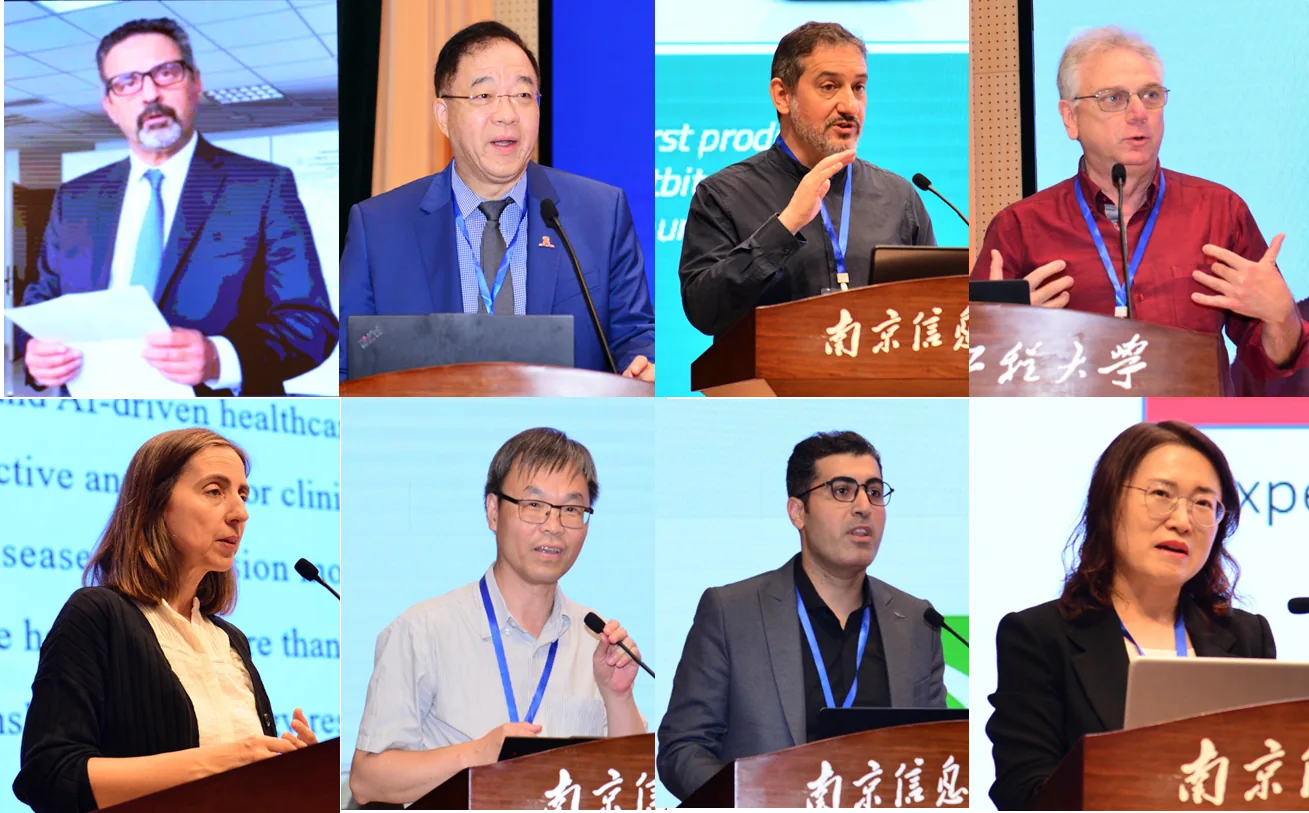
Pictured: Speakers at the conference. First row: João Sàágua, President of the New University of Lisbon, Portugal; Academician Qin Ling of the Chinese University of Hong Kong; Professor Hugo Gamboa of the New University of Lisbon, Portugal; Professor Giovanni Saggio of the Sapienza University of Rome, Italy; Second row: Professor Ana Londral of the New University of Lisbon, Portugal; Professor Zhou Huiyu of the University of Leicester, the United Kingdom; Professor Hamada Rizk of Osaka University, Japan; Professor Kim Jeong-sil of Kyungpook National University, South Korea.
Summer school schedule: Integrating international teachers and cultivating professional talents
This artificial intelligence summer school invited many internationally renowned experts to teach, providing students with the opportunity to systematically learn medical artificial intelligence knowledge.
On July 9, the eve of the official schedule of the entire conference, Professor S. Y. Kung from Princeton University in the United States gave a master class with the theme of “The Golden Age of Artificial Intelligence Environment - Equipment, Data and Deep Learning”. Professor Gong Sanyuan has been deeply involved in academic frontiers for a long time. He has outstanding achievements and rich experience in the field of artificial intelligence and is a highly respected authoritative figure in the academic community. When he came to the summer school this time, he taught everything he had learned, thought, and realized without reservation. In class, Professor Gong Sanyuan used vivid language and rich and detailed cases to explain the three pillars of artificial intelligence in a simple and easy-to-understand manner: the device side, the data side, and the cutting-edge theories and technical applications of deep learning. During the teaching process, Professor Gong also set up interactive sessions to encourage students to actively ask questions and boldly express their thoughts and opinions. The students spoke enthusiastically and had a lively discussion with Professor Gong. The atmosphere was very active. On July 27, Professor Chen Zhiyuan from the University of Nottingham, UK, gave the students a course themed “Modern Pattern Recognition Technology and Methods”. Combining her own research results, she systematically explained the basic theories of linear regression and classification, deeply analyzed unsupervised learning algorithms and their engineering practices, and strengthened the application and transformation of theoretical knowledge through experimental sessions, supplemented by in-class practice, so that students could have a deeper understanding of this field. At the same time, the trainees also experienced the scientific research results and teaching methods in related fields from abroad, especially the United Kingdom and Malaysia, which increased their knowledge, cultivated skills, broadened their horizons, and enriched their knowledge. On the morning of July 29, Professor Hugo Gamboa from the New University of Lisboa in Portugal continued to explain in depth the relevant knowledge of biological signal analysis, including the entire process perspective of biological signal collection, processing, feature extraction and information analysis. He also invited students to come to the stage to experience physiological signal acquisition and monitoring. Under the guidance of Professor Hugo, several students used wearable devices to measure their own electromyography, skin and acceleration signals, and transmitted these signals to the computer via Bluetooth, giving the students a more comprehensive understanding of this cutting-edge technology. In the afternoon, Professor Ana Rita Londral presented a series of research projects to students based on the research motivation of developing technology to improve patient outcomes and medical services and based on the concept of Value-Based Healthcare, including optimizing patient care through wearable technology and portable medical devices, and using medical data to improve service efficiency. On the morning of July 30, Professor Giovanni Saggio from the Sapienza University of Rome, Italy, introduced in detail the principles and applications of digital twin technology in biomedical applications. Through simulation experiments and case analysis, students experienced the charm of this technology first-hand. During the case presentation session, the professor focused particularly on the treatment scenarios for Parkinson’s patients: he presented on the screen a digital twin model based on the patient’s real physiological data. The model could not only accurately reproduce the patient’s tremor frequency, muscle tension and other symptom characteristics, but also simulate the impact of different drug doses and rehabilitation training programs on the condition. This enables students to intuitively understand how this technology can provide accurate reference for the formulation of personalized treatment plans for Parkinson’s patients, and also deeply feel the potential of digital twin technology in improving the treatment effect of neurological diseases. In the afternoon, Professor Zhou Huiyu from the University of Leicester, UK, gave the students a lecture on cutting-edge technologies of computer vision and large language models. He introduced the latest research results and development trends, which broadened the students’ horizons. It also focuses on the basic principles and technologies of computer vision systems currently used in practical applications, as well as the research and development methods of new systems. It aims to help students master the basic principles and technologies of image processing and large language models, and cultivate practical abilities in computer vision software design and implementation. In addition, based on his many years of experience in the international academic community, he introduced the process and precautions for submitting manuscripts to international journals in detail.
On the afternoon of July 30, the closing ceremony of this event was held. The host, Professor Hugo Gamboa, announced on behalf of the conference that the International Medical Artificial Intelligence Conference and the Artificial Intelligence Summer School were successfully concluded, and expressed his gratitude to the experts for their wonderful reports and the students’ active participation.
Looking to the future: Deepening international cooperation to jointly contribute to a healthy China
This conference and summer school successfully established a high-level international exchange platform, effectively promoting academic dialogue, technology sharing and industry-university-research collaborative innovation in the field of medical artificial intelligence. Nanjing University of Information Science & Technology will continue to expand cooperation with world-class universities and institutions, promote education integration, scientific research collaboration and industry advancement in the field of medical artificial intelligence, and contribute wisdom and strength to the construction of “Healthy China” and the transformation of global medical intelligence.
Translated from the original Chinese source.