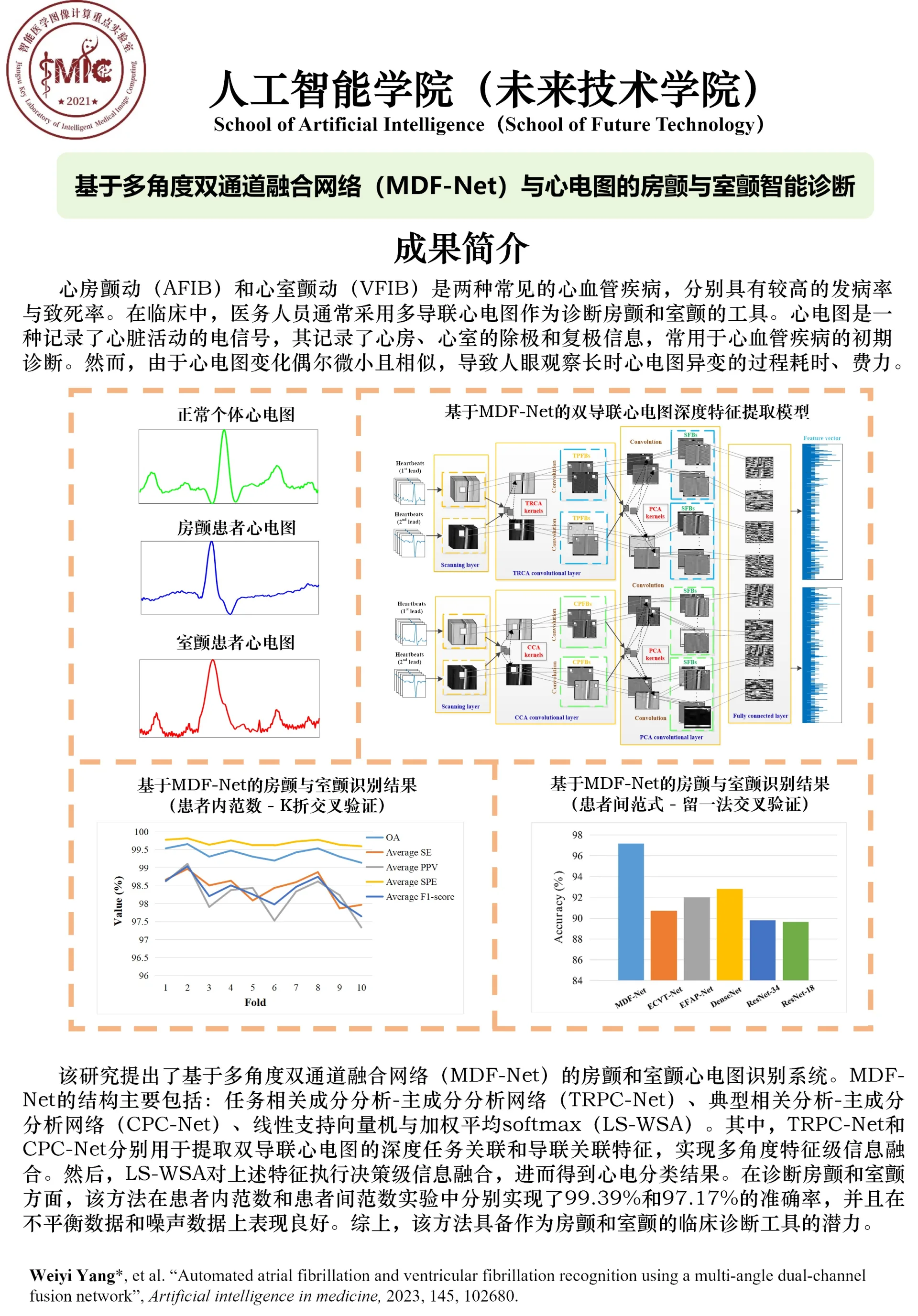
Diagnosis of atrial fibrillation and ventricular fibrillation based on multi-angle dual-channel fusion network and electrocardiogram
- IMIC Lab
- Research , Research results
- December 6, 2024

The 20th China-U.S. Frontier Science Symposium, jointly organized by the Chinese Academy of Sciences and the U.S. National Academy of Sciences, was held from November 18 to 21 at the Friendship Palace of the Friendship Hotel in Beijing. Nearly a hundred young scientists from more than 40 Chinese and American research institutions and universities, including the Chinese Academy of Sciences, Tsinghua University, Peking University, Harvard University, MIT, and Lawrence Berkeley National Laboratory, conducted in-depth exchanges and interdisciplinary discussions on related cutting-edge science and technology topics. The conference carried out in-depth exchanges and discussions around topics such as artificial intelligence promoting scientific development, connectomics of neurological diseases, exoplanets, in situ structural cell biology, nanopore biotechnology analysis, ocean carbon dioxide removal, future-oriented quantum materials, and using new mathematical tools to understand artificial intelligence. As one of the important platforms for interdisciplinary exchanges between the academies of sciences of the two countries and even for young scholars from both countries, the Sino-US Frontier Science Symposium organizes interdisciplinary discussions around different themes in the field of natural sciences. Scientists from both sides learn from each other in the field of basic research through the symposium, which enhances friendship and broadens their horizons, and plays a positive role in strengthening exchanges between the young scientific communities of the two countries. Luo Yuemei was invited to attend the meeting of the “Artificial Intelligence Promotes Scientific Development” branch and gave a poster presentation on “Automated OCT-Based Retinal Disease Detection: Innovations and Applications in Semi-Supervised Deep Learning” on behalf of the Key Laboratory of Intelligent Medical Image Computing.
Read More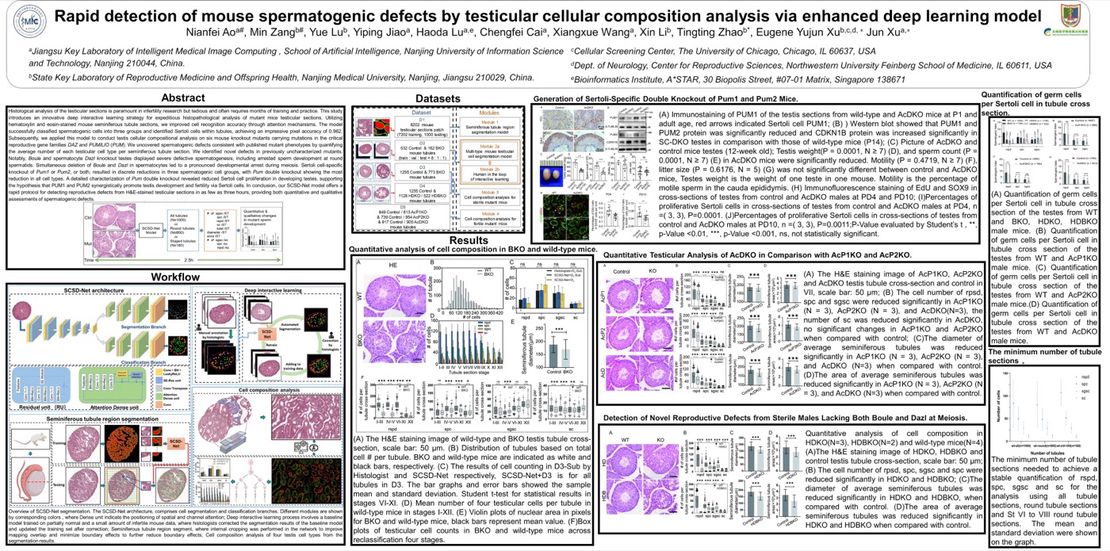
Professor Xu Jun’s team and Professor Xu Yujun’s team from the State Key Laboratory of Reproductive Medicine at the University of Chicago/Nanjing Medical University have pioneered the application of machine learning technology in the quantitative analysis of conventional H&E pathological sections of mouse testicles, and carried out automated staging and identification of spermatogenesis through quantitative analysis of histological sections of spermatogenesis. Recently, the collaborative team expanded this method to the rapid detection of spermatogenesis defects in male infertile mice. This collaborative work recently caused great repercussions at the 2024 Andrology Conference in the United States (see the picture below). At this meeting, participants from the field of reproductive medicine in the United States had extensive and in-depth interactions and exchanges with Professor Xu Yujun on issues related to the feasibility of using machine learning to identify mice containing fertility defect genes. This work was published in Andrology, the leading journal in the field of andrology.
Read More