Analysis of testicular cell composition based on enhanced deep learning model to rapidly detect spermatogenic defects in mice

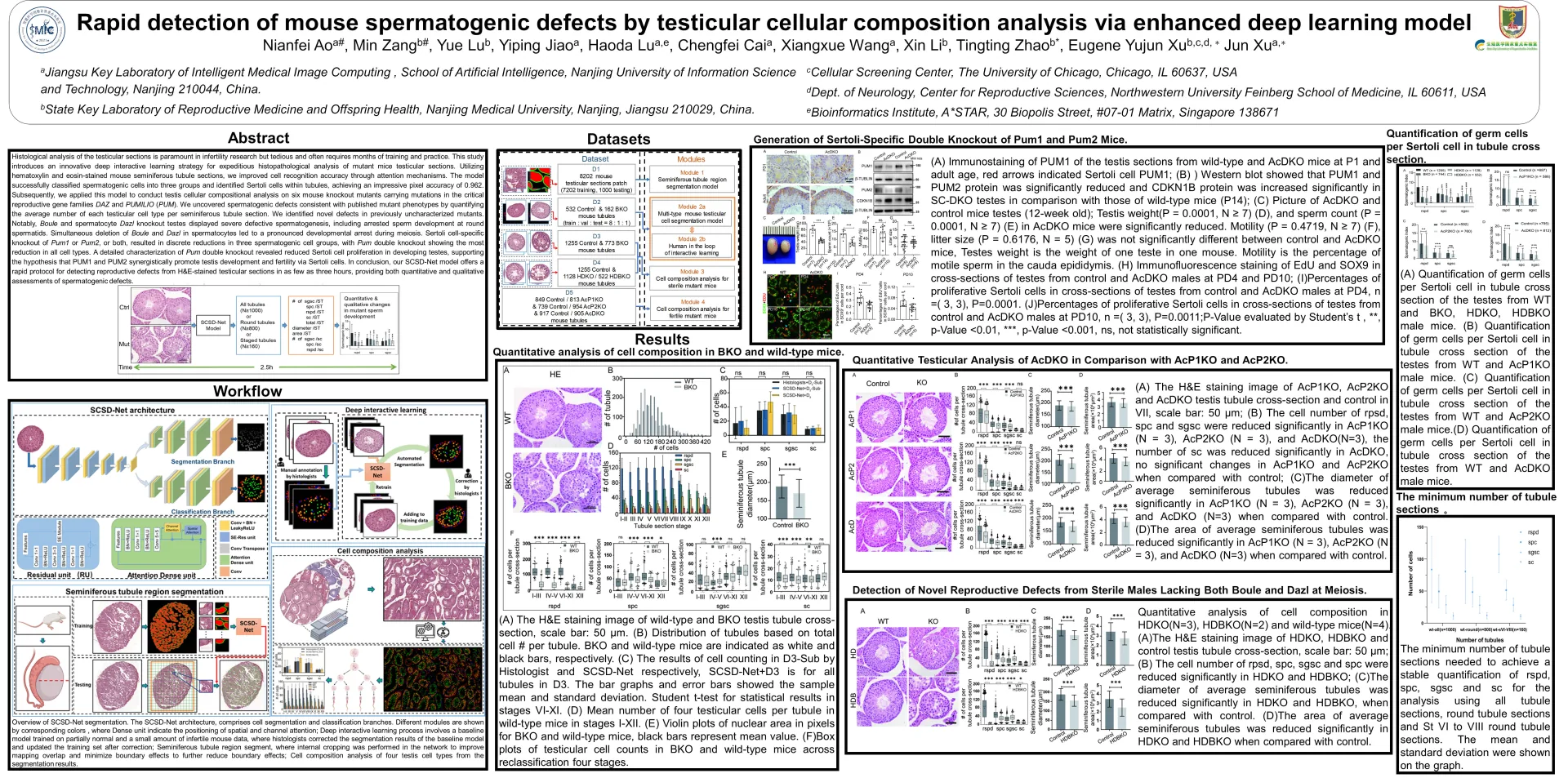
Professor Xu Jun’s team and Professor Xu Yujun’s team from the State Key Laboratory of Reproductive Medicine at the University of Chicago/Nanjing Medical University have pioneered the application of machine learning technology in the quantitative analysis of conventional H&E pathological sections of mouse testicles, and carried out automated staging and identification of spermatogenesis through quantitative analysis of histological sections of spermatogenesis. Recently, the collaborative team expanded this method to the rapid detection of spermatogenesis defects in male infertile mice. This collaborative work recently caused great repercussions at the 2024 Andrology Conference in the United States (see the picture below). At this meeting, participants from the field of reproductive medicine in the United States had extensive and in-depth interactions and exchanges with Professor Xu Yujun on issues related to the feasibility of using machine learning to identify mice containing fertility defect genes. This work was published in Andrology, the leading journal in the field of andrology.
Analysis of testicular cell composition based on enhanced deep learning model to rapidly detect spermatogenic defects in mice

Picture: Poster of the latest research results of Professor Xu Jun’s team and Professor Xu Yujun presented at the 2024 Andrology Conference in the United States

Nianfei Ao, Min Zang, Yue Lu, Yiping Jiao, Haoda Lu, Chengfei Cai, Xiangxue Wang, Xin Li, Minge Xie, Tingting Zhao, Jun Xu, Eugene Yujun Xu,Rapid detection of mouse spermatogenic defects by testicular cellular composition analysis via enhanced deep learning model, Andrology , 2024.


Translated from the original Chinese source.
Share :

Related Posts

Xu Jun attended the first annual meeting of the Asian Society of Digital Pathology and gave an academic report

Xu Jun attended the first annual meeting of the Asian Society of Digital Pathology and gave an academic report

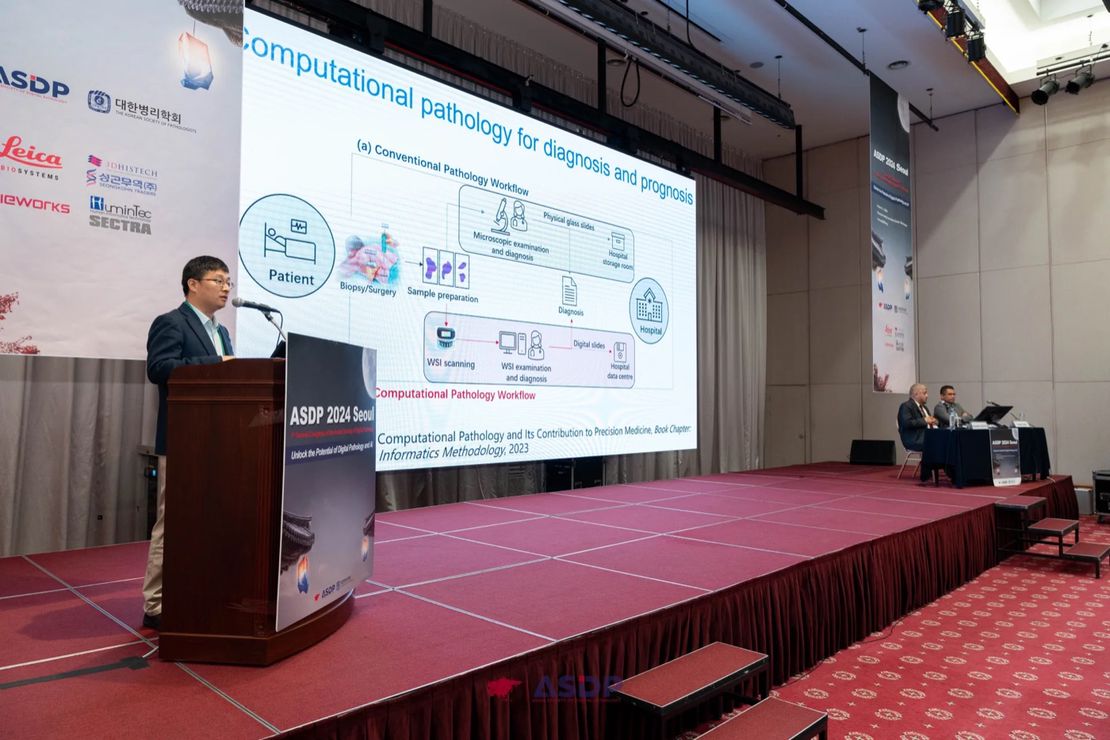
The first annual meeting of the Asian Society of Digital Pathology will be held on October 2-4, 2024 at the Sejong University Conference Center in Seoul, South Korea. The theme of this annual meeting is: Unlock the Potential of Digital Pathology and AI. The conference invited pathologists from the United States, Europe, and Asia, university professors engaged in digital pathology and artificial intelligence research, digital pathology engineers, and experts in the field of digital pathology. Xu Jun was invited to attend the conference and gave an academic report titled: Explainable AI in Pathology (Explainable Artificial Intelligence in Pathology), and also chaired the academic report of the Generative AI and LLM in Pathology (Generative AI and Large Language Model in Pathology) branch.

Read More
2024

2024

Wei Zhou, Hangyu Zhu, Wei Chen, Chen Chen, and Jun Xu, Outlier Handling Strategy of Ensembled-Based Sequential Convolutional Neural Networks for Sleep Stage Classification. Bioengineering , 2024, 11, 1226. [ Link to paper ]

Read More
Yang Weiyi

Yang Weiyi

Yang Weiyi, Ph.D., is currently a lecturer at the School of Artificial Intelligence of Nanjing University of Information Science & Technology, a core member of the Jiangsu University Key Laboratory of Intelligent Medical Image Computing and the Smart Medical Research Institute, and a youth committee member of the Chinese Research Hospital Association. He graduated from the School of Communication Engineering of Jilin University with a bachelor’s degree and a doctoral degree, and received his doctorate in October 2022. He went to the Department of Biomedical Engineering at McGill University for joint training and studied under Robert E Kearney, an academician of the Canadian Academy of Engineering and an academician of the American Academy of Biomedical Sciences. Now he is mainly engaged in research in the fields of biomedical signal processing and the development of intelligent diagnostic systems. Currently, he is presiding over the Jiangsu Provincial Basic Research Program Natural Science Foundation (2024.09-2027.08). He has published more than 20 SCI academic papers in high-level international journals such as “Information Sciences”, “Knowledge-based systems”, and “Artificial intelligence in medicine”. Google Scholar shows that the paper has been cited more than 500 times, with the highest number of citations for a single article being 152 times. He has served as a reviewer for high-level SCI journals such as Information Fusion and Information Sciences. Has applied for multiple invention patents, 4 of which have been authorized.

Read More