2024
- IMIC Lab
- Research , Paper published
- March 27, 2024
Wei Zhou, Hangyu Zhu, Wei Chen, Chen Chen, and Jun Xu, Outlier Handling Strategy of Ensembled-Based Sequential Convolutional Neural Networks for Sleep Stage Classification. Bioengineering , 2024, 11, 1226. [ Link to paper ]
Xiao Gan*, Palanivelu Sengottaiyan, Kyu Hyong Park, Sarah M. Assmann*, Réka Albert*, A network-based modeling framework reveals the core signal transduction network underlying high carbon dioxide-induced stomatal closure in guard cells, PLOS Biology, 22(5): e3002592, May 1, 2024. [ Link to paper ]
Lei Tao, Jin Qian, Changhao Gong, Dingfa Zhang, and Yuemei Luo*, Cross-Domain Retinopathy Classification in Optical Coherence Tomography Images Based on Domain Adversarial Graph Convolutional Network, IEEE Sensors Journal , 2024. [ Link to paper ]
Bowen Zheng, Chenxi Huang, Yuan Li, Zhiyuan Zheng, and Yuemei Luo*, Detecting Retinopathy from Optical Coherence Tomography Images Using a Novel Augmentation-based Semi-supervised Learning Approach, IEEE Sensors Journal , 24(18), 29284-29292 (2024). [ Link to paper ]
Songqi Hu, Hongying Tang, and Yuemei Luo*, Identifying Retinopathy in Optical Coherence Tomography Images with Less Labeled Data via Contrastive Graph Regularization, Biomedical Optics Express , 15(8), 4980-4994 (2024). [ Link to paper ]
Yuemei Luo, Chenxi Huang, Chaohui Lin, Yuan Li, Jing Chen, Xiren Miao, and Hao Jiang, Distortion Tolerant Method for Fiber Bragg Grating Sensor Network Using Estimation of Distribution Algorithm and Convolutional Neural Network, IEEE Transactions on Instrumentation and Measurement , 2024. [ Link to paper ]
Bowen Zheng, Chenxi Huang, Xiangji Chen, and Yuemei Luo*, Towards Head Computed Tomography Image Reconstruction Standardization with Deep Learning Assisted Automatic Detection, IEEE Transactions on Instrumentation and Measurement , 73, 1-14 (2024). [ Link to paper ]
Fuyu Li, Wenlong Ming, Wenxiang Lu, Ying Wang, Xianjun Dong, Yunfei Bai, Bioinformatics advances in eccDNA identification and analysis, Oncogene , August 29, 2024. [ Link to paper ]
Jiaming Yu, Nan Chen, Jun Li, Li Xue, Riqing Chen, Changcai Yang, Lanyan Xue, Zuoyong Li, Lifang Wei, LC-MANet: Location-constrained joint optic disc and cup segmentation via multiplex aggregation network, Computers and Electrical Engineering , 2024, 118: 109423. [ Link to paper ]
Yifan Gao, Lifang Wei, Jun Li, Xinyue Chang, Yulong Zhang, Riqing Chen, Changcai Yang, Yi Wei, Heng Dong, MCCSeg: Morphological embedding causal constraint network for medical image segmentation, Expert Systems with Applications , 2024, 249: 123666. [ Link to paper ]
Chengfei Cai, Qianyun Shi, Jun Li, Yiping Jiao, Andi Xu, Yangshu Zhou, Xiangxue Wang, Chunyan Peng, Xiaoqi Zhang, Xiaobin Cui, Jun Chen, Jun Xu, Qi Sun, Pathologist-level diagnosis of ulcerative colitis inflammatory activity level using an automated histological grading method, International Journal of Medical Informatics , 2024, 192: 105648. [ Link to paper ]
Guo Guanchen, Li Jun, Cai Chengfei, Jiao Yiping, Xu Jun, Transformer medical image segmentation method based on causal constraints, Frontiers of Data and Computing Development, 2024, 6(2): 89-100. [Link to paper]
Cai Chengfei, Li Jun, Jiao Yiping, Wang Xiangxue, Guo Guanchen, Xu Jun, Progress and challenges of medical multimodal data fusion methods based on deep learning in oncology, Frontiers of Data and Computing Development, 2024, 6 (3): 3 ~ 14. [Link to paper]
Abu Bakor Hayat Arnob, Xiangxue Wang, Yiping Jiao, Xiao Gan, Wenlong Ming, and Jun Xu, Pathological primative segmentation based on visual foundation model with zeroshot mask generation, the 21st IEEE International Symposium on Biomedical Imaging (ISBI 2024) , Athens Greece, May 27th30th, 2024. [ Link to paper ]
Lei Gao, Weilang Wang, Xiangpan Meng, Shuhang Zhang, Jun Xu, Shenghong Ju, Yuancheng Wang, TPA: Two‐stage progressive attention segmentation framework for hepatocellular carcinoma on multi‐modality MRI, Medical Physics , 2024. [ Link to paper ]
Xuemei Lan, Guanchen Guo*, Xiaopo Wang, Qiao Yan, Ruzeng Xue, Yufen Li, Jiaping Zhu, Zhengbang Dong, Fei Wang, Guomin Li, Xiangxue Wang, Jun Xu, Yiqun Jiang, Differentiation and risk stratification of basal cell carcinoma with deep learning on histopathologic images and measuring nuclei and tumor microenvironment features, Skin Research and Technology , 2024; 30: e13571. [ Link to paper ]
Jinze Li, Yi Xiang, Jiahao Han, Youfang Gao, Ruiying Wang, Zihe Dong, Huihui Chen, Ruixia Gao, Chuan Liu, GaoJun Teng, Xiaolong Qi, Retinopathy as a predictive indicator for significant hepatic fibrosis according to T2DM status: A cross-sectional study based on the national health and nutrition examination survey data, Annals of Hepatology, 2024 Feb 12:101478. [ Link to paper ]
Chengfei Cai, Jun Li, Mingxin Liu, Yiping Jiao, Jun Xu, SeqFRT: Towards Effective Adaption of Foundation Model via Sequence Feature Reconstruction in Computational Pathology, IEEE International Conference on Bioinformatics and Biomedicine , 2024. [ Link to paper ] (Oral Presentation)
Kai Yang, Mucheng Ren, Jun Xu, and Xian Zeng, Dynamic Prediction of Intraoperative Hypotension Based on Hemodynamic Monitoring Data with a Transformer-Based Deep Learning Model, IEEE International Conference on Bioinformatics and Biomedicine Workshop MABM2024 . [ Link to paper ]
Xiaodong Wang, Jun Xu, Gaojun Teng, A Respiratory Signal Monitoring Method Based on Dual-Pathway Deep Learning Networks in Image-Guided Robotic-Assisted Intervention System, The International Journal of Medical Robotics and Computer Assisted Surgery , vol. 20(6):e70017, 2024 . [ Link to paper ]
Jun-hao Zha, Tian-yi Xia, Zhi-yuan Chen, Tian-ying Zheng, Shan Huang, Qian Yu, Jia-ying Zhou, Peng Cao, Yuan-cheng Wang, Tian-yu Tang, Yang Song, Jun Xu, Bin Song, Yu-pin Liu, Sheng-hong Ju, Fully automated hybrid approach on conventional MRI for triaging clinically significant liver fibrosis: A multi-center cohort study, Journal of Medical Virology , 96(8):e29882, 2024. [ Link to paper ]
Xinmi Huo, …, Jun Xu, …, Weimiao Yu & Soo Yong Tan, A comprehensive AI model development framework for consistent Gleason grading, Communications Medicine , vol 4, no.84, 2024. [ Link to paper ]
Haoda Lu, Longjie Li, Kokhaur Ong, Yufan Wang, Yiping Jiao, Xiangxue Wang, Chengfei Cai, Jing Zhang, Jun Hou, Huanfen Zhao, Hualei Gan, Wanyuan Chen, Xinmi Huo, Lihua Zhang, Weimiao Yu, and Jun Xu, AI-Based Computational Pathology and Its Contribution to Precision Medicine, Series on Language Processing, Pattern Recognition, and Intelligent Systems, Frontiers in Bioimage Informatics Methodology , pp. 167-193, 2024. [ Link to paper ]
Chengfei Cai, Yangshu Zhou, Yiping Jiao, Liang Li, Jun Xu. “Prognostic Analysis Combining Histopathological Features and Clinical Information to Predict Colorectal Cancer Survival from Whole-Slide Images.” Digestive Diseases and Sciences (2024): 1-11. [ Link to paper ]
Zhu, Jianjun, Cheng Wang, Sitong Teng, Jian Lu, Pengju Lyu, Pujun Zhang, Jun Xu, Ligong Lu, and Gao‐Jun Teng. “Embedding expertise knowledge into inverse treatment planning for low‐dose‐rate brachytherapy of hepatic malignancies.” Medical Physics 51, no. 1 (2024): 348-362. [ Link to paper ]
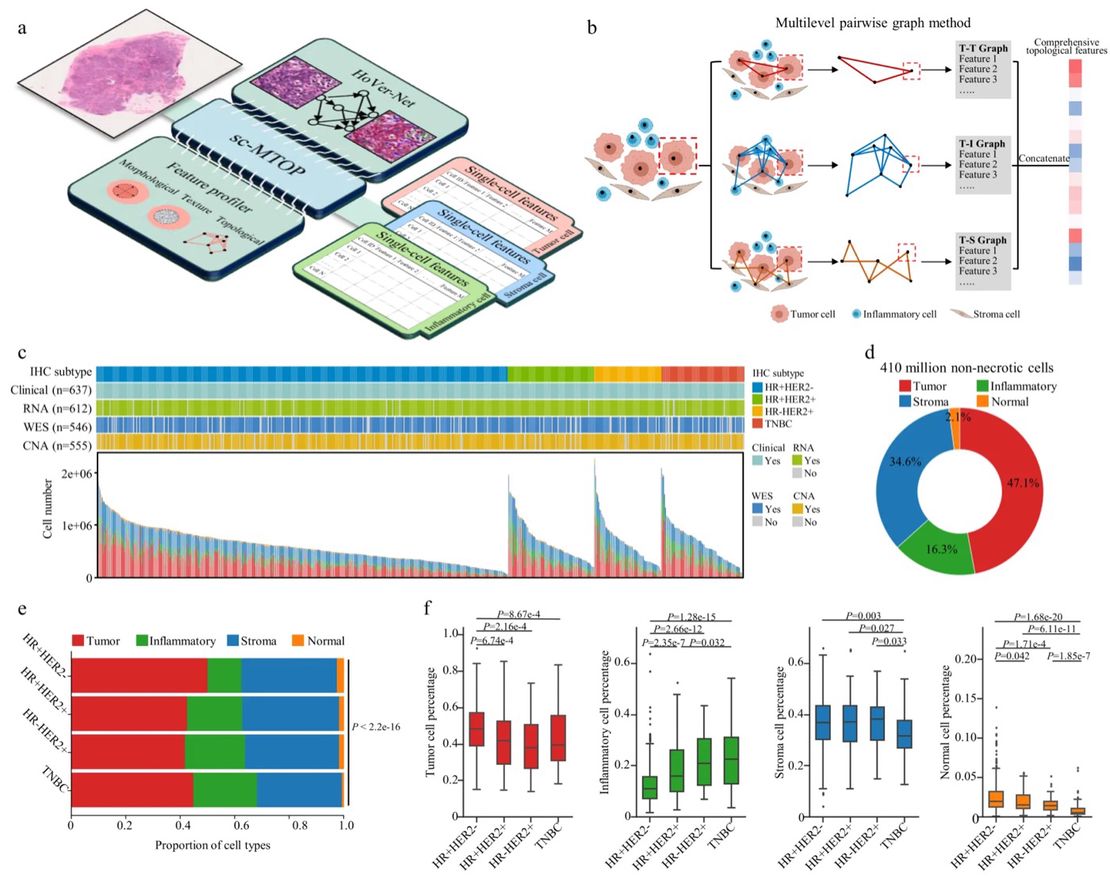
Shen Zhao, Chao-Yang Yan, Hong Lv, Jing-Cheng Yang, Chao You, ZiAng Li*, Ding Ma, Yi Xiao, Jia Hu, Wen-Tao Yang, Yi-Zhou Jiang, Jun Xu, and Zhi-Ming Shao, Deep learning framework for comprehensive molecular and prognostic stratifications of triple-negative breast cancer, Fundamental Research , Volume 4, Issue 3, May 2024, Pages 678-689. [ Link to paper ]
Translated from the original Chinese source.