The research results of teachers from the Smart Medical Research Institute in the Science sub-journal reveal the modern scientific explanation of the principle of "syndrome differentiation and treatment" of traditional Chinese medicine
- IMIC Lab
- News , Comprehensive news
- October 28, 2023
Recently, Dr. Gan Xiao, a member of the team of Professor Xu Jun of the Smart Medical Research Institute of the School of Artificial Intelligence of Nanjing University of Information Science & Technology, Professor Zhou Xuezhong of Beijing Jiaotong University, the founder of network science, an academician of the European Academy of Arts and Sciences, and Professor Albert-László Barabási of Northeastern University, as well as a joint team including the China Academy of Chinese Medical Sciences and the Hubei Provincial Hospital of Traditional Chinese Medicine published a research paper “Network medicine framework reveals” in Science Advances (a top journal of the Chinese Academy of Sciences, impact factor IF=13.6). “generic herb-symptom effectiveness of Traditional Chinese Medicine (network medicine theory reveals the universal rules of clinical efficacy of traditional Chinese medicine)”, Dr. Gan Xiao of our hospital is the first author and co-corresponding author. This paper found that the traditional treatment principle of “syndrome differentiation and treatment” of traditional Chinese medicine can be explained by the topological proximity relationship between traditional Chinese medicine and disease symptoms on the protein network, and was verified by real-world clinical data. It was the first time to explore and establish a scientific theory to explain the principle of traditional Chinese medicine treatment system.
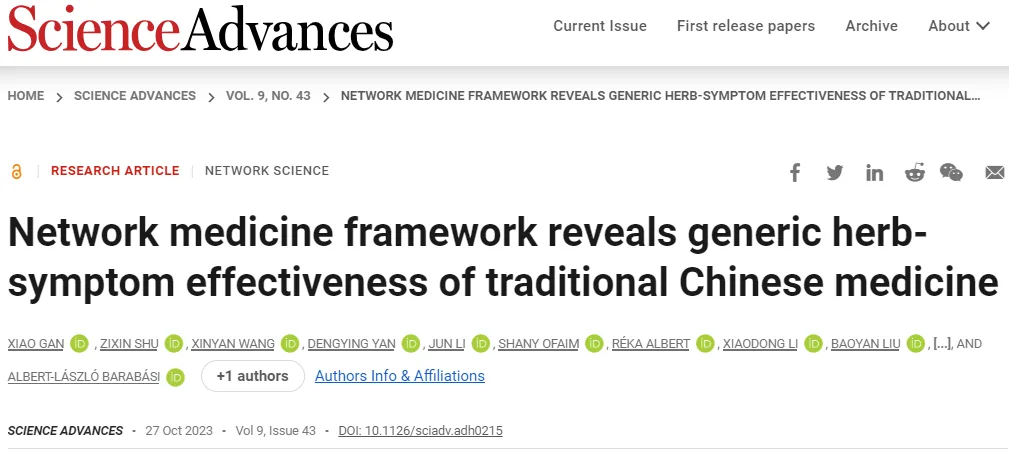
Paper link: https://www.science.org/doi/10.1126/sciadv.adh0215
Research background
Traditional Chinese medicine is a traditional medical system with unique advantages and characteristics in my country. It has significant clinical efficacy. Scientific explanation of the treatment laws of traditional Chinese medicine is an urgent need for the modernization of traditional Chinese medicine and a priority development area of the country’s “14th Five-Year Plan”. Syndrome differentiation and treatment, as the main clinical diagnosis and treatment method of traditional Chinese medicine, is an individualized diagnosis and treatment system with traditional Chinese medicine characteristics based on the four diagnostic methods of traditional Chinese medicine and symptoms and signs, involving complex system laws such as drugs, diseases, and the human body. Therefore, “explaining and clarifying the clinical efficacy of traditional Chinese medicine” is still an unsolved problem. As an important part of syndrome differentiation and treatment, the mechanism of clinical efficacy of traditional Chinese medicine-symptoms (drug-disease relationship) that carries the universal law of addition and subtraction according to the disease needs to be elucidated, which is a key scientific issue related to the clinical efficacy of traditional Chinese medicine and pharmacological research of traditional Chinese medicine. In recent years, with the help of the increasingly complete human protein interaction network, emerging Western medicine network medicine theories and methods have revealed that Western medicine targets and disease-associated proteins have universal topological proximity relationships on the human protein network.
Research results
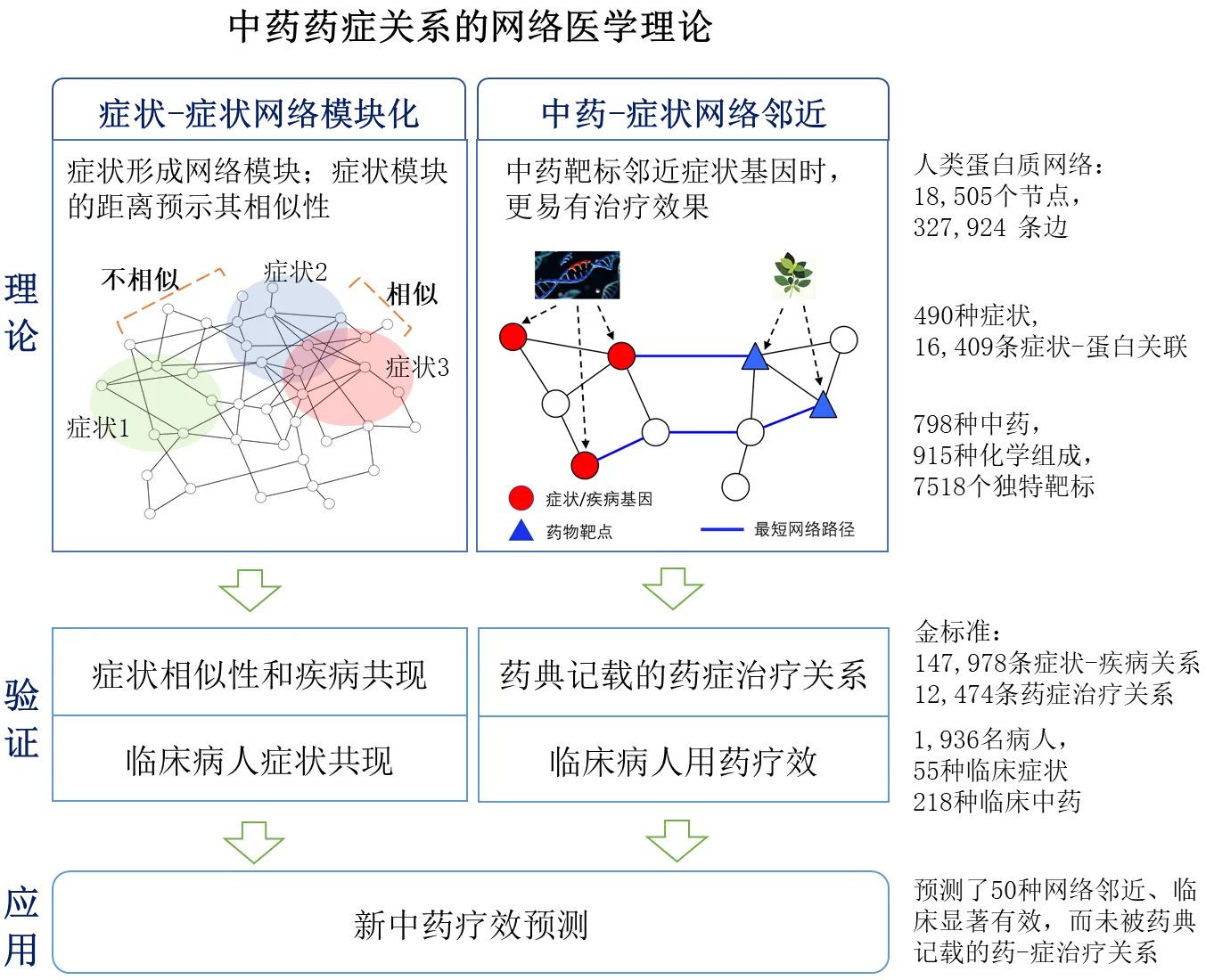
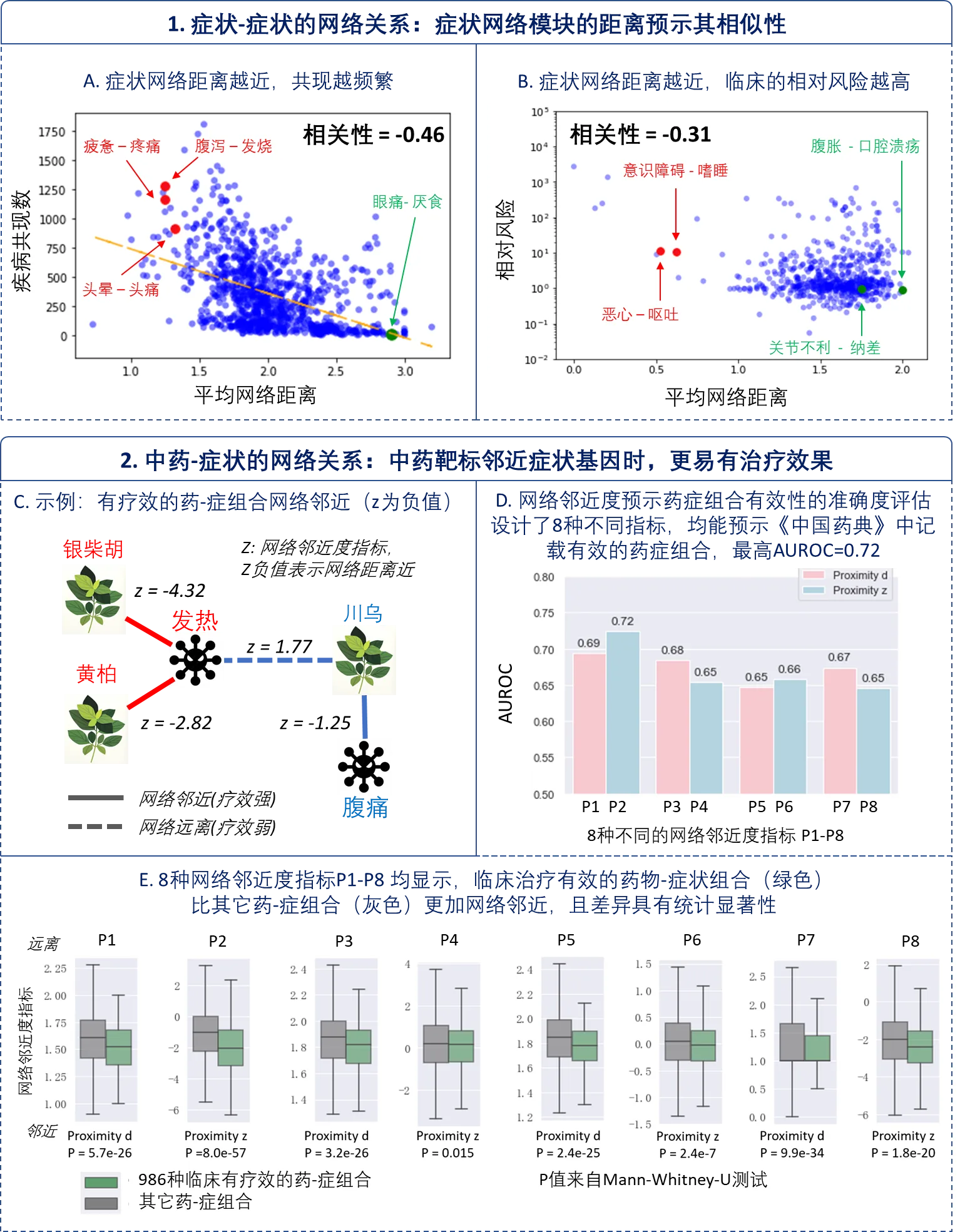
In this paper, Dr. Gan Xiao proposed the network medicine theory and method of traditional Chinese medicine. He believed that the “prescribing the right medicine” in clinical syndrome differentiation and treatment of traditional Chinese medicine can be explained by the topological proximity relationship between traditional Chinese medicine targets and symptom-related protein modules on the complete human protein network. The paper first proposed and verified the modularity of symptom-related genes on the human protein network. The closer the network distance of symptom modules is, the easier it is for symptoms to co-occur. Then, the paper points out that there is a universal network proximity relationship between curative Chinese medicines and symptoms, that is, Chinese medicine targets are more likely to be curative when they are close to symptom-associated proteins. It also proposes a variety of network proximity indicators as mathematical models to quantitatively describe this proximity relationship. Subsequently, the paper systematically verified the network proximity law of the clinical efficacy of traditional Chinese medicine-symptoms through effective traditional Chinese medicine-symptoms recorded in the Chinese Pharmacopoeia and real-world hospital clinical patient data. Finally, the paper points out that the network proximity relationship on the human protein network can be used as an indicator for predicting the efficacy of traditional Chinese medicine and drug redirection, and predicts a series of drug-disease combinations that are not recorded in the “Chinese Pharmacopoeia” but are significantly effective in clinical data, as potential Chinese medicine treatment options.
Significance and prospects
This work is an original scientific theory. It is the first time that a modern scientific explanation of the treatment principles of traditional Chinese medicine is proposed from the perspective of complex networks and systems, and its effectiveness is verified based on real-world clinical data. This is also the first time that a systematic scientific theory of traditional Chinese medicine has been published in a top journal at the Science sub-journal level, which is of great significance for promoting the modernization and internationalization of traditional Chinese medicine. This study establishes a new research paradigm on the principles of traditional Chinese medicine and indicates that the complete human protein network may be the next hot topic in pharmacological research on traditional Chinese medicine. Finally, the traditional Chinese medicine network medicine theory proposed in the paper may be transformed into applications such as efficacy prediction and drug redirection of new traditional Chinese medicines/medicinal compounds.
Paper citations
Xiao Gan et al., Network medicine framework reveals generic herb-symptom effectiveness of traditional Chinese medicine. Sci.Adv.9,eadh0215(2023).DOI:10.1126/sciadv.adh0215
Author introduction

Gan Xiao, male, graduated from the Science Intensive Department of Kuang Yaming College of Nanjing University and received his PhD from the Department of Physics of Pennsylvania State University in the United States. After graduating from the Ph.D., he served as a postdoctoral researcher at Northeastern University and Pennsylvania State University, studying under Professor Albert-László Barabási, an academician of the European Academy of Arts and Sciences and the founder of network science. Dr. Gan Xiao’s main research direction is complex networks and their modeling in biomedical systems. As the first author or co-first author, he has published papers in top journals such as Science Advances, PNAS, Phys. Rev. E., etc., with a total of more than 600 citations (Google Scholar).
Google Scholar homepage:
https://scholar.google.com/citations?user=EOFin10AAAAJ&hl=en
Chinese homepage:
https://faculty.nuist.edu.cn/ganxiao/zh_CN/index.htm
Translated from the original Chinese source.