Teachers from the Smart Medical Research Institute published papers in the Nature cooperation series of journals
- IMIC Lab
- News , Comprehensive news
- June 8, 2023
Recently, Dr. Li Jin and Dr. Wang Xiangxue, members of Professor Xu Jun’s team at Nanjing University of Information Science & Technology - Zhongda Hospital Smart Medical Research Institute, published two papers respectively in the authoritative journal “npj Digital Medicine” (District 1, Chinese Academy of Sciences, Top Journal, impact factor IF=15.357) and “npj Precision Oncology” (impact factor IF=10.092) in the Nature collaboration series.
Paper 1
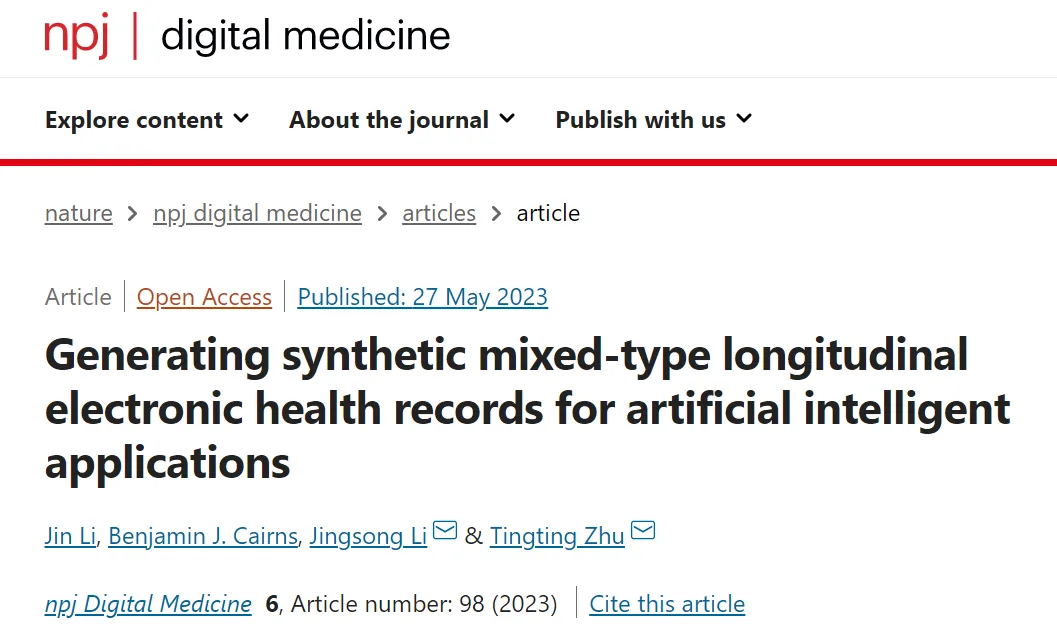
For a research paper titled “Generating synthetic mixed-type longitudinal electronic health records for artificial intelligent applications”, Professor Li Jin from our institute is the first author. Paper link: https://www.nature.com/articles/s41746-023-00834-7
Paper 2
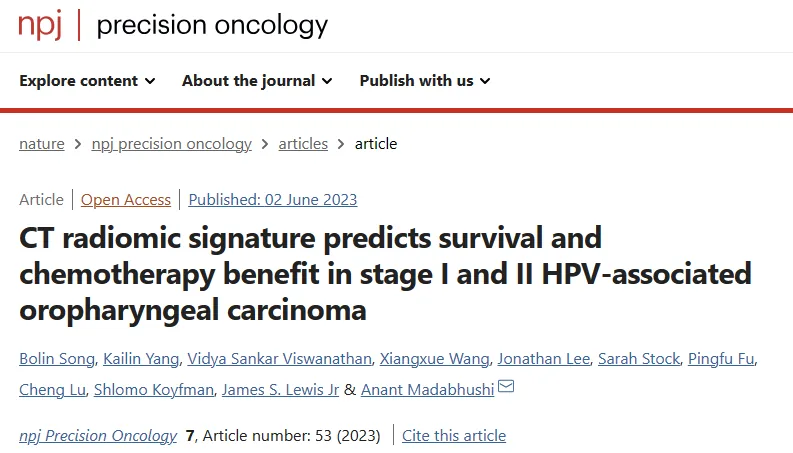
In the research paper titled “CT radiomic signature predicts survival and chemotherapy benefit in stage I and II HPV-associated oropharyngeal carcinoma”, Professor Wang Xiangxue from our hospital is a participating author, and the cooperating units are Case Western Reserve University, Emory University, Georgia Tech University and Vanderbilt University School of Medicine. Paper link: https://www.nature.com/articles/s41698-023-00404-w
Introduction to the article
Paper 1
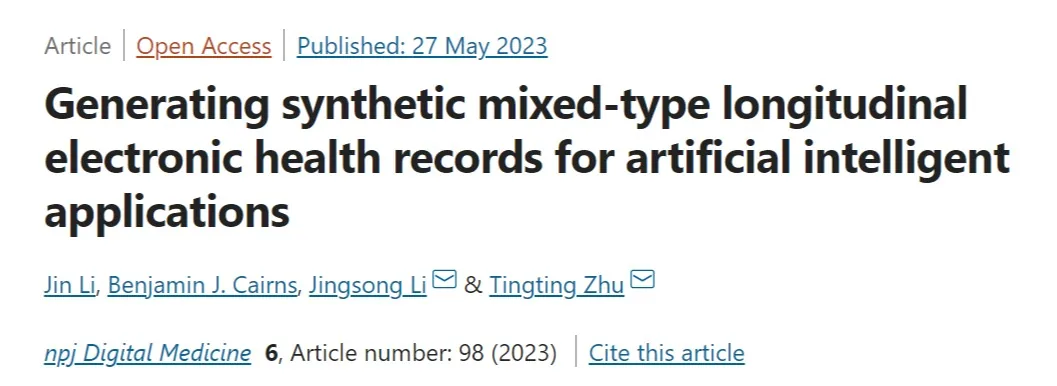
Research background: Patient health data represented by electronic medical records (EHR) is a data type that is widely used in the medical field. Its huge value has promoted breakthroughs in computational health informatics research in recent years. However, the need for privacy protection of patient data limits data sharing among medical institutions, making it difficult for researchers to gain access to clinical data. Generated data (Synthetic data) is an effective alternative. High-quality generated data can retain the characteristic information in the original data distribution and can be used for downstream clinical data mining tasks. However, current data generation models for electronic medical records have limitations. Existing methods often only target a single data type and cannot model the correlation between high-dimensional and complex clinical data.
Research method: In order to solve the above problems, this study proposes a data generation model based on Generative Adversarial Network (GAN) that can generate continuous and discrete time-series electronic medical records at the same time. This model can generate heterogeneous and high-dimensional patient time-series features while capturing potential correlation information between features. The model is first based on a dual variational autoencoder under multiple loss constraints (variational lower bound, contrastive learning loss, etc.) to map data existing in variable domains of different feature types into a latent space with a unified high-order feature representation; then, the dynamic correlation between continuous and discrete time series data is captured through a coupled loop generator.
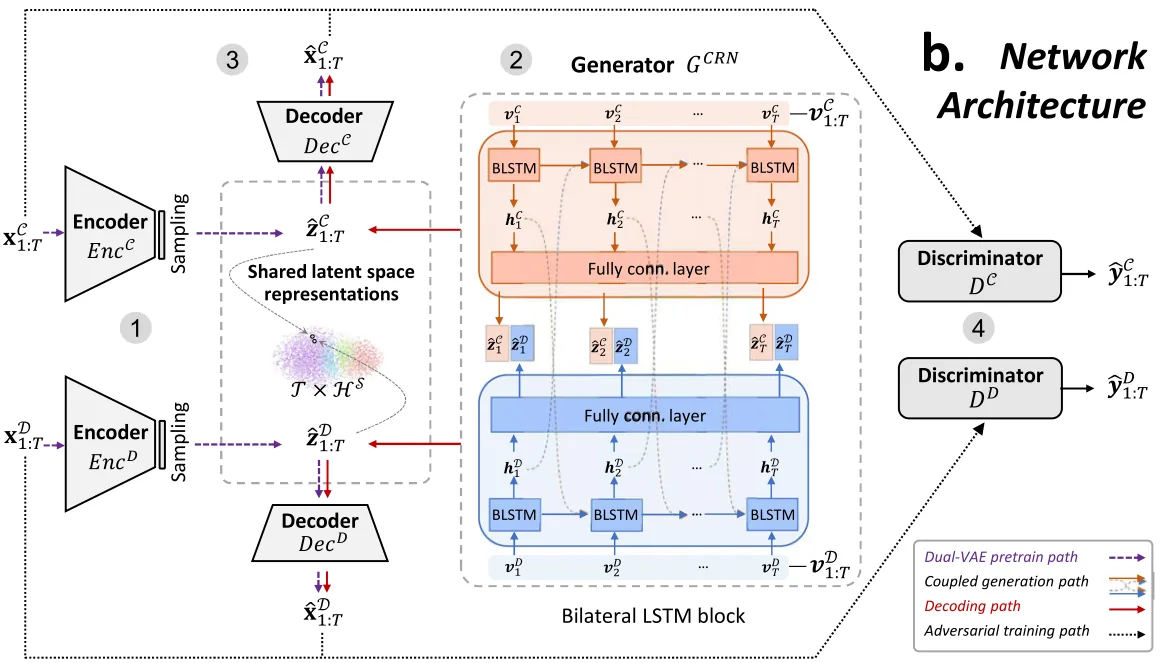
Research results: This study verified the effectiveness of the proposed data generation model on three critical care databases (MIMIC-III, eICU, HiRID). The research results show that the time-series electronic medical record data generation method proposed in this study has achieved good performance in terms of authenticity, relevance, usability and privacy of the generated data.
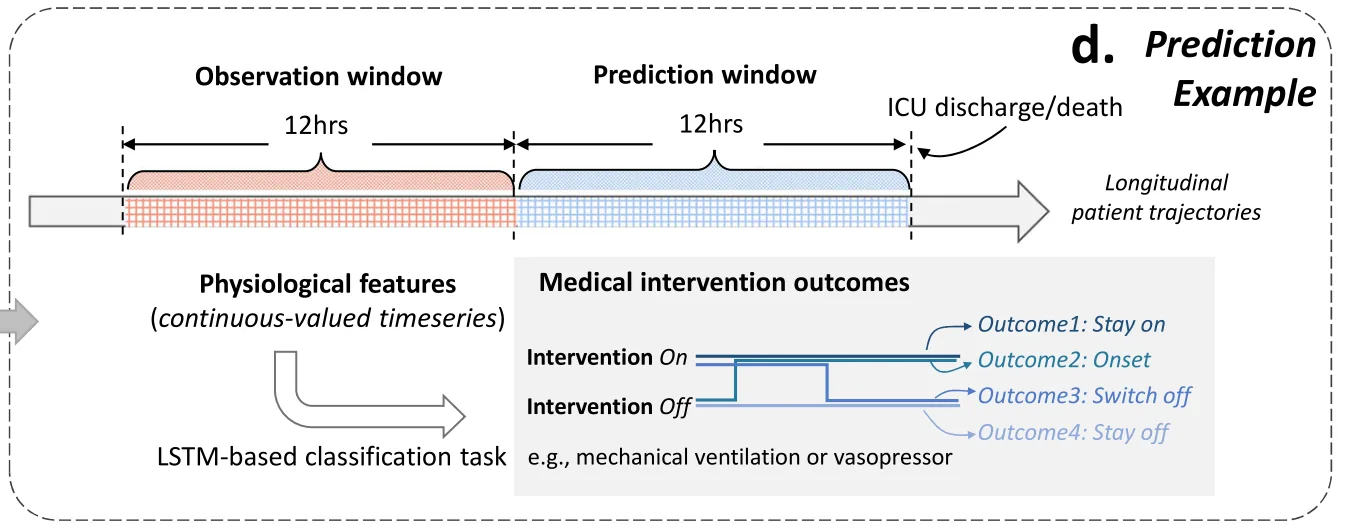
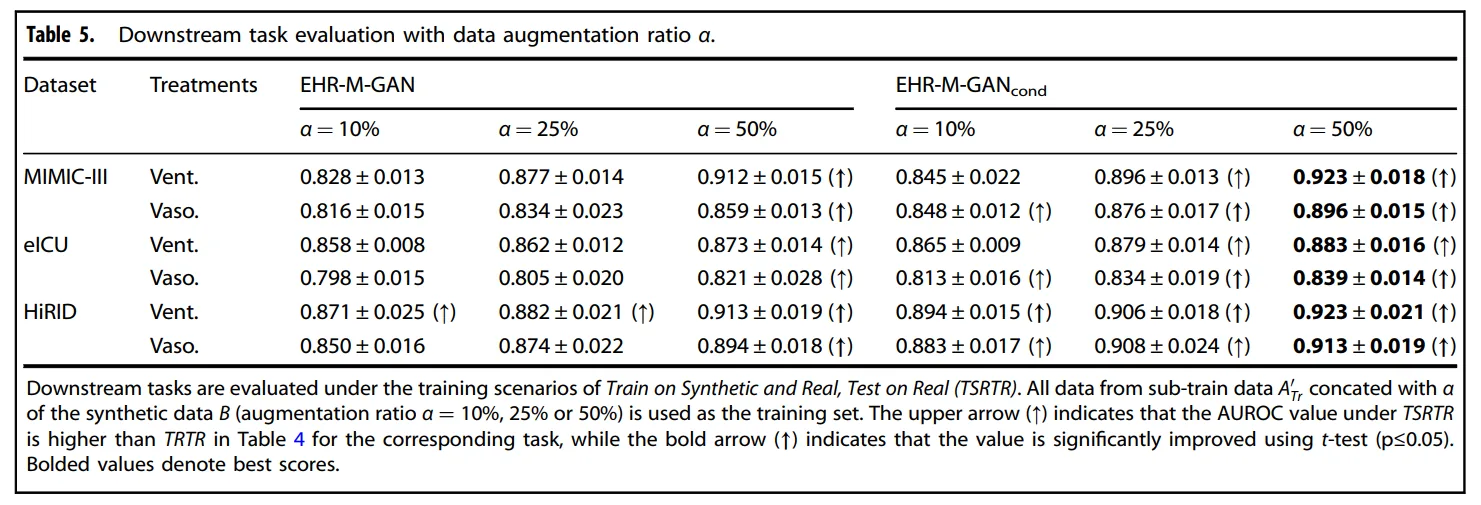
Conclusion and Outlook: In view of the difficulties such as high cost and long cycle in the clinical electronic medical record data collection process, the data generation model proposed in this study helps researchers develop medical artificial intelligence models more efficiently by providing high-quality, multi-type generated time-series electronic data while meeting the premise of protecting patient data privacy. Future research can further expand the scope of application of data generation methods to adapt to the needs of multiple data modalities emerging in clinical practice, thereby enhancing the application value of medical artificial intelligence in clinical practice.
Author introduction

Li Jin, female, holds a PhD in Biomedical Engineering from Zhejiang University. During her PhD, she went to the IBME Institute of Oxford University in the UK for joint training. Will work at Nanjing University of Information Science & Technology from September 2022. The main research directions include the secondary utilization of electronic medical record data and the development of clinical intelligent auxiliary decision-making systems. As the first author, he has published many papers in top journals in the fields of npj Digital Medicine, Artificial Intelligence in Medicine and other fields. Participated in the completion of several scientific research projects such as the National Natural Science Foundation of China, the National Key Research and Development Program, and the British National Institute of Health NIHR. Google Scholar homepage: https://scholar.google.com.hk/citations?user=DiFoVRIAAAAJ&hl=zh-CN&oi=sra; ResearchGate homepage: https://www.researchgate.net/profile/Li-Jin-38
Paper 2

Background: The incidence of human papillomavirus (HPV)-related oropharyngeal cancer (OPSCC) has increased significantly over the past few decades. Patients with HPV-associated OPSCC show better response to chemoradiotherapy treatment and prognosis than patients with HPV-independent OPSCC, whose tumors are more commonly associated with alcohol and tobacco use. Previous research has shown that using concurrent chemotherapy and radiation therapy as a final treatment option reduces local and regional recurrence rates in high-risk oropharyngeal cancer compared with radiation therapy alone. However, the addition of chemotherapy may result in increased treatment-related toxicity, which is a particular concern for patients with low-risk HPV-associated oropharyngeal cancer. Radiomics aims to identify minute image-based attributes related to tumor phenotype and prognosis, helping not only to identify the presence of disease in radiological images but also to identify features associated with disease outcome and treatment response. However, to date no method has been available to assess the utility of these methods in predicting chemotherapy benefit in patients with HPV-related OPSCC.
Research Methods: To address the above issues, this study developed a prognostic and predictive radiomics image signature (pRiS), which utilizes quantitative textural features of the inside and outside of primary throat tumors in pre-treatment CT scans to predict survival and chemotherapy benefit. Using a total of 491 patients from 4 centers who received radiotherapy + chemotherapy or radiotherapy alone, we aimed to investigate whether pRiS (a) has predictive value for survival in patients with AJCC stage I and II HPV-related OPSCC and (b) is associated with chemotherapy benefit. pRiS resamples all CT images to isotropic voxel size of 1mm before feature extraction, and then extracts gray-level intensity features, gray-level co-occurrence matrix (GLCM), Haralick features, Laws energy, Gabor wavelet-based features and intensity gradient direction features (CoLlAGe). To investigate whether pRiS adds incremental prognostic value for personalized prediction of OS and DFS, we constructed a comprehensive radiomarker score (Mrad+c) by combining pRiS with prognostic clinical factors and compared it with a clinical score (Mc).
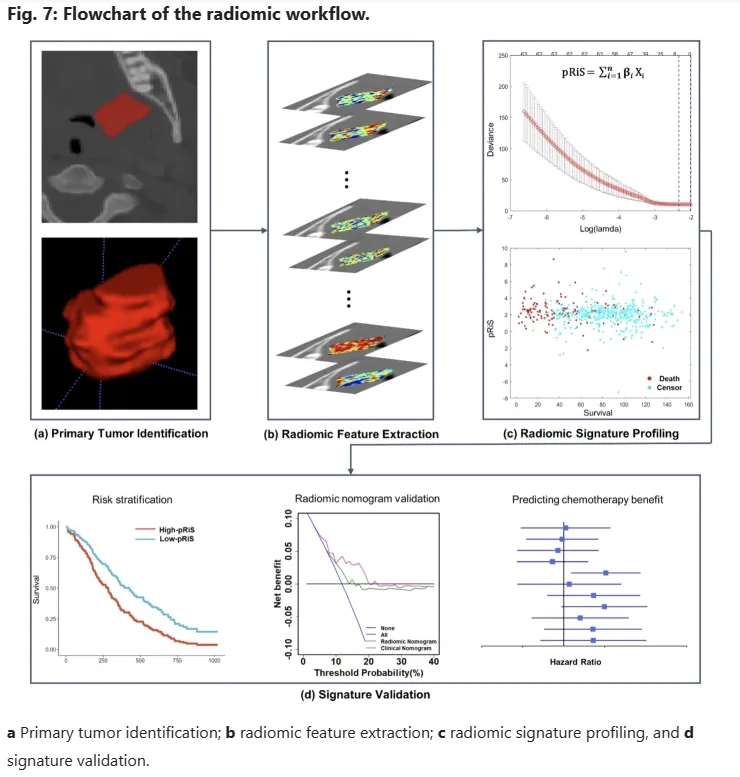
Findings: This study found that combination therapy with chemotherapy and radiotherapy improved overall survival in patients with high pRiS, whereas chemotherapy did not improve overall survival in patients with low pRiS, suggesting that these patients receive no additional benefit from chemotherapy and may consider attenuating treatment. The proposed radiographic signature signature is predictive of patient survival and chemotherapy benefit in patients with stage I and II HPV-related oropharyngeal cancer.
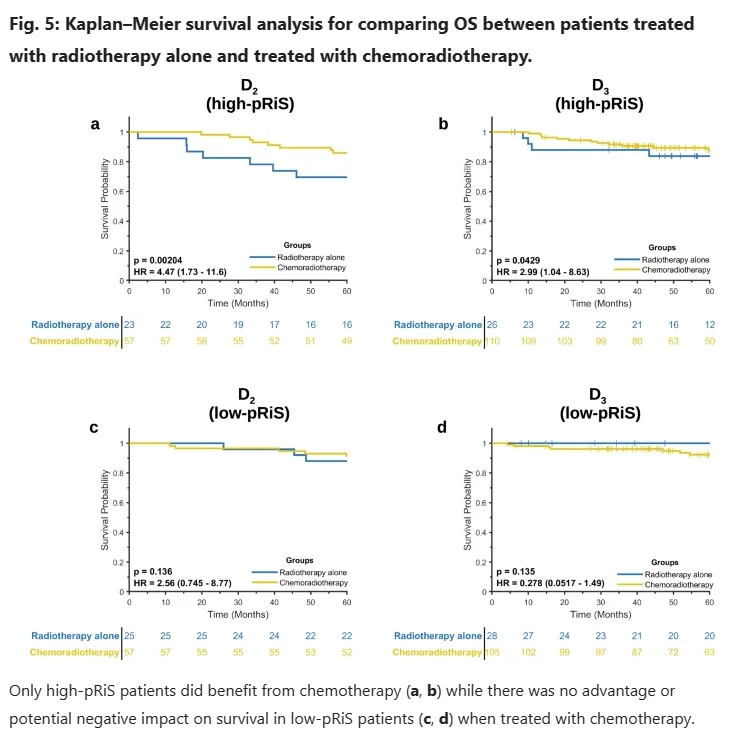
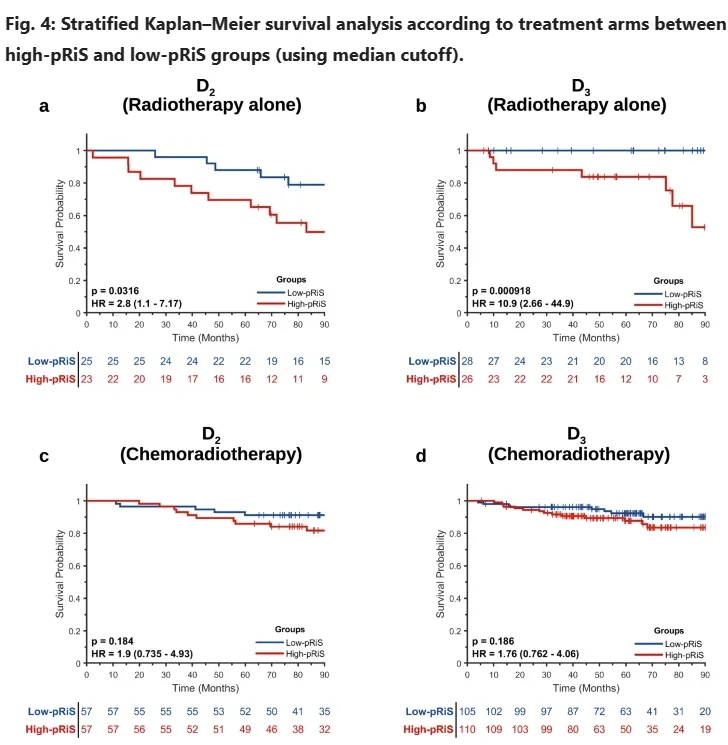
Conclusions and Outlook: The novelties of this study are: (a) pRiS was shown to be predictive not only of prognosis in OPSCC patients but also of the additive benefit of chemotherapy; (b) compared to analyzing patients with different HNSCC subtypes, pRiS specifically investigated the role of chemotherapy in patients with AJCC 8th edition I and II HPV-related OPSCC. The findings of this study can guide future studies to design more powerful predictive biomarkers to enable precision treatment of HPV-related OPSCC.
Author introduction

Wang Xiangxue, male, is an associate professor at the School of Artificial Intelligence, Nanjing University of Information Science & Technology, and a Ph.D. in biomedical engineering from Case Western Reserve University (USA). The main research directions are computational pathology and multi-modal medical data fusion to predict cancer prognosis and treatment response. As the first author, he has published papers in top journals such as Science Advances, Lancet Ebiomedicine, and Clinical Cancer Research, with a total of more than 1,000 citations. Google Scholar homepage: https://scholar.google.com/citations?user=M-h-Qc0AAAAJ&hl=en; Chinese homepage: https://faculty.nuist.edu.cn/wangxiangxue/zh_CN/index.htm
Translated from the original Chinese source.