MICS Computational Pathology Special Topic and the Second Computational Pathology Symposium were successfully held
- IMIC Lab
- News , Comprehensive news
- January 19, 2023
On the morning of January 14, 2023, the MICS Computational Pathology Special Topic and the Second Computational Pathology Symposium were held online through Tencent Conference. The meeting discussed the future development direction and latest technological progress of computational pathology in the form of roundtable discussions and invited reports. This meeting was particularly honored to invite Professor Liang Zhiyong, chairman of the Pathology Branch of the Chinese Medical Association, Professor Liu Dongge, the incoming chairman, Professor Bu Hong, the former chairman, as well as senior experts in the field of pathology such as Professor Liang Li and Professor Song Zhigang to give speeches and roundtable discussions. This meeting received the guidance of the three previous chairmen of the Pathology Branch of the Chinese Medical Association, which reflects the great importance that the Pathology Branch of the Chinese Medical Association attaches to the development of the field of computational pathology in my country. Topics discussed at the roundtable mainly include: the construction of pathology-specific disease databases, the advancement of digital pathology and computational pathology industry standards and expert consensus, and the application and implementation of computational pathology and digital pathology, etc. These topics have an important leading role in the future development of computational pathology in my country.
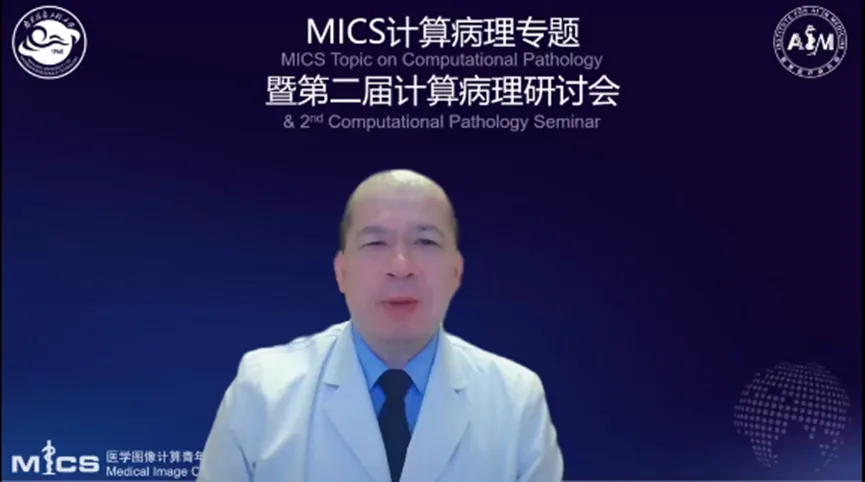
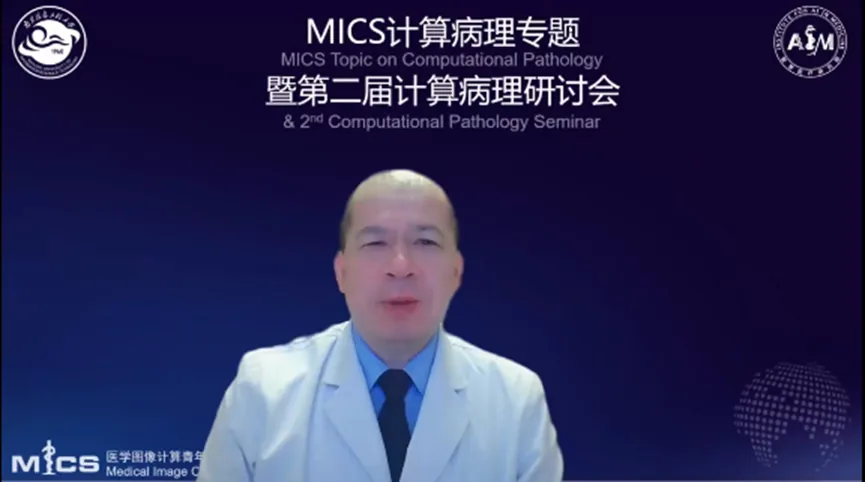
Professor Liang Zhiyong, Chairman of the Pathology Branch of the Chinese Medical Association, delivered a speech
Professor Liang Zhiyong, chairman of the Pathology Branch of the Chinese Medical Association and director of the Pathology Department of Peking Union Medical College Hospital, said in his speech that the development of pathology benefits from the development and application of new technologies. Computational pathology is the result of cross-collaboration between doctors and engineers. It is a new branch of pathology and a new direction for the development of our pathology. How to better apply technologies such as artificial intelligence to our pathology work is also a direction that we pathologists have been working hard and exploring. Therefore, we very much look forward to receiving support from related interdisciplinary fields, especially the engineering field. It is expected that this conference will promote more cooperation and exchanges between engineering experts and pathology experts, jointly promote the development of domestic computational pathology, and truly lead the development of related fields internationally. Professor Xu Jun, as the chairman of the seminar and the chairman of the 4th Medical Image Computing Youth Symposium (MICS), on behalf of MICS and Nanjing University of Information Science & Technology - Zhongda Hospital Smart Medical Research Institute, thanked Professor Liang Zhiyong, Professor Liu Dongge, Professor Bu Hong, Professor Liang Li, Professor Song Zhigang, Professor Yu Weimiao, Professor Xu Yan, Professor Liao Jun, Professor Wang Liansheng, and all MICS Committee members, pathologists, experts, teachers and classmates attended this meeting and wished all experts a happy Spring Festival and happiness to their families. I would like to express my highest respect and holiday greetings to all pathologists and medical staff who are fighting on the front line of the epidemic!
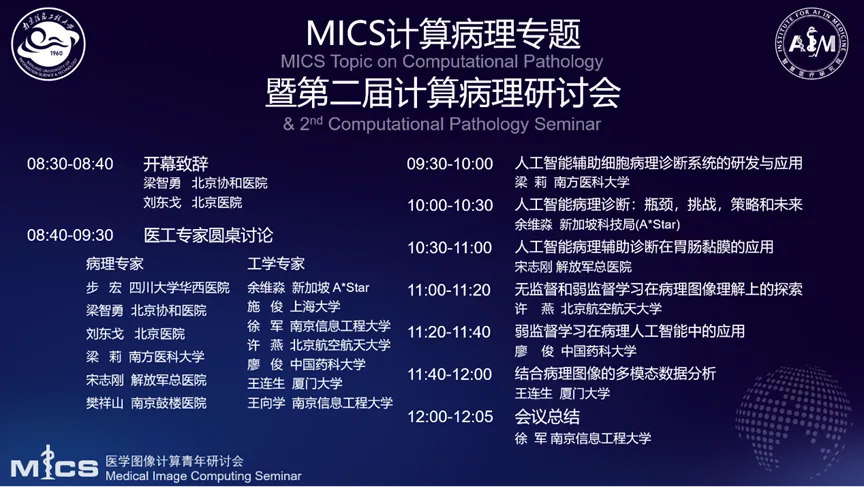
Seminar poster and content schedule
At the meeting, Professor Xu Jun introduced the background of MICS and this meeting to the guests and experts. He said that computational pathology is a field that is highly integrated with digital pathology and artificial intelligence technology represented by machine learning and digital image processing. As the digitization of pathological slides is widely adopted in clinical practice and artificial intelligence technology widely penetrates into the field of pathology, computational pathology will become a transformative technology in the field of traditional pathology. In the field of computational pathology, my country and Western developed countries started almost at the same time. Therefore, attaching importance to and developing the field of computational pathology is very critical for my country to occupy the commanding heights of global science and technology in this field and solve “stuck neck” technical problems. Since this field involves the fields of digital pathology and artificial intelligence and is a cutting-edge medical-engineering intersection, it requires the joint efforts of my country’s pathology experts and engineering experts to effectively promote its development. At the same time, this field has broad development space and prospects, as well as important clinical application value. Only since 2017 has digital pathology begun to be gradually accepted and adopted clinically on a large scale around the world. The gradual digitization of pathology departments is the development trend and direction. Under the leadership and promotion of the three previous chairmen of the Pathology Branch of the Chinese Medical Association: Professor Bu Hong, Professor Liang Zhiyong, and Professor Liu Dongge, my country has made great progress in the field of digital pathology and computational pathology, but it still faces many challenging problems that need to be solved. Toward this goal, this conference focuses on the latest cutting-edge research progress in the field of computational pathology and digital pathology, current challenges, and future development directions, etc. Roundtable discussions and invited academic reports. It is hoped that this conference can lead the next development direction of the field of computational pathology in my country.
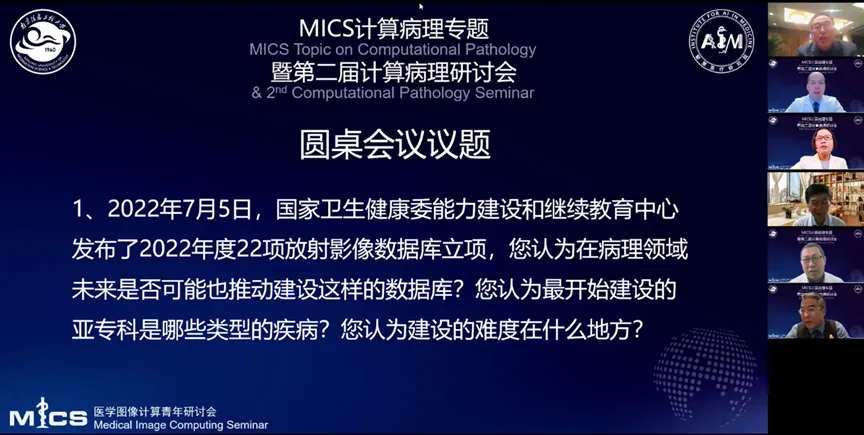
Lively discussion on topics at roundtable meeting of medical and engineering experts
During the roundtable session, the three previous chairmen of the Pathology Branch of the Chinese Medical Association and various pathology and engineering experts conducted many leading discussions on the construction of pathology databases, future application scenarios of computational pathology or pathology AI, issues of slice digitization standards, pathological AI labeling issues and challenges, etc. This has important guiding significance for guiding subsequent research and implementation in the field of computational pathology in my country. The invited academic lectures were also full of useful information. Pathology experts and engineering experts introduced computer-aided diagnosis of cytopathology, gastrointestinal tumors and inflammatory lesions, prostate cancer, etc., as well as computational pathology methods based on unsupervised and weakly supervised learning, multi-instance and even cross-modal heterogeneous data fusion methods, and also involved novel applications of Transformer, knowledge distillation, heterogeneous Graph and other methods in the field of computational pathology.
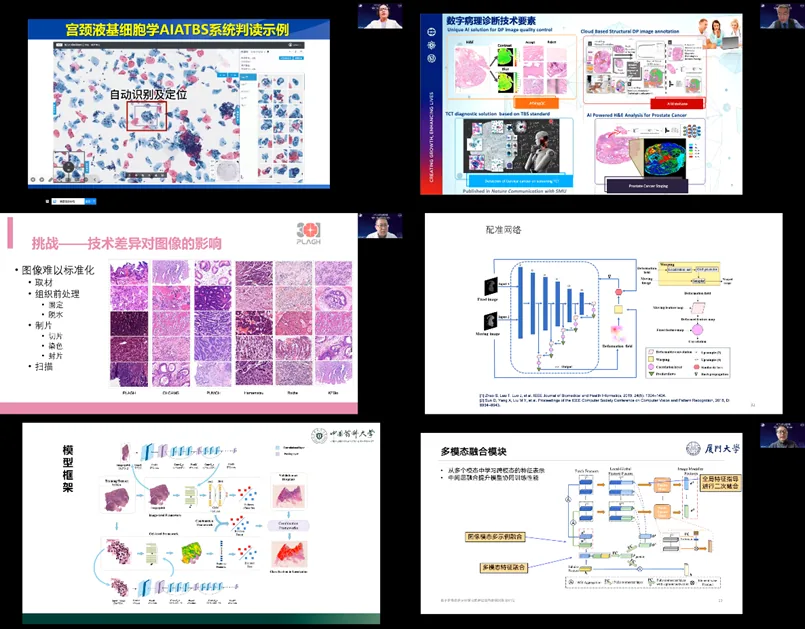
Exciting special guest reports
Professor Liang Li, Director of the Pathology Department of Southern Medical University, introduced the application and practice of artificial intelligence cytopathology-assisted diagnosis and treatment. Professor Yu Weimiao from the Singapore Institute of Technology conducted a detailed analysis and discussion on the development status, challenges and bottlenecks of artificial intelligence-assisted pathological diagnosis. The report also made a detailed analysis and discussion on the development and ecological environment of computational pathology and digital pathology industries, and how to promote the rapid development of artificial intelligence-assisted pathological diagnosis in the future. Professor Song Zhigang from the Department of Pathology of the People’s Liberation Army General Hospital gave an in-depth discussion on the characteristics of pathological slices and the application and practice of artificial intelligence pathological-assisted diagnosis in gastrointestinal mucosa. Professor Xu Yan from Beijing University of Aeronautics and Astronautics conducted a good exploration of unsupervised and weakly supervised learning problems such as the lack of actual labels in pathological images, and introduced cutting-edge research results based on unsupervised and weakly supervised learning. Liao Jun of China Pharmaceutical University gave a detailed introduction to the strong supervised learning model and the latest weakly supervised learning model for pathological images. Professor Wang Liansheng of Xiamen University made important sharing on pathological image processing, multi-modal data fusion and other work. The guests participating in this conference are all senior experts in the field of pathology and computational pathology in my country. The participating experts come from pathology, engineering and other disciplines. The conference has a distinctive feature of medical-engineering intersection. This conference is hosted by the Medical Image Computing Youth Symposium (MICS) and Nanjing Information Engineering-Zhongda Hospital Smart Medical Research Institute. The meeting was simultaneously broadcast live through Tencent Conference, Bilibili, and Kouxiang Academic, with thousands of medical and engineering experts participating online.
It is reported that the computational pathology seminar was initiated by Professor Xu Jun of the Smart Medical Research Institute. The first conference was held in November 2021, and scholars in the field of computational pathology at home and abroad were invited to give cutting-edge academic reports. This conference is the second computational pathology seminar organized by the Smart Medical Research Institute. The conference will be postponed in 2022 due to the impact of the epidemic. The Computational Pathology Symposium is planned to be held annually. Influential experts in the field of computational pathology at home and abroad are invited to give academic reports and discussions. It is committed to promoting mutual understanding, exchange and cooperation between engineering experts and pathology experts, and discussing and exchanging the latest cutting-edge technologies in the field of computational pathology. At the same time, it will promote international cooperation and exchanges in the field of computational pathology in my country and promote the development of computational pathology and digital pathology in my country.
Translated from the original Chinese source.